My trusty Timbuk2 messenger bag reeks of the sweetness that only salted flesh and fat can devise. For weeks now I've been picnicing with various cured meats and cheeses from myriad European markets, but here and now in Italy the sheer meaty madness has reached it's zenith. Yesterday it was lardo that I paired with a succulent walnut sauce meant for pasta, but equally fulfilling as a dip for fat wrapped Tuscan bread. Today though, is a treat the likes of which you don't stumble on every day. Most great Italian cured meats are widely available in the U.S. either as imported products or domestic representations. I've made plenty of them in my capacity as both a chef and hobbyist. Like any import though, some of the true gems don't readily make it out of the homelad. Today I have ripening in my bag as I trudge the streets of Firenze the Calabrian specialty: Nduja (in-doo-ya). Similar to salami only in that it's made from ground pork, heavily spiced and salted, and stuffed into intestinal casing to be smoked and aged; nduja is soft and spreadable. Native to Calabria it has a characteristic firey pepper flavor. Don't let it's bladderesque appearence fool you...this is an epic treat for someone as geeky as myself.

Heretoforth, I had only indulged in nduja (say that five times fast!) once. As far as I know there is only one place in the United States producing this product and I can now attest having had it in the homeland that their's is an exemplary recreation, true to form and flavor in every way. Boccalone of the Ferry Building in San Francisco brought nduja to my attention when Chris Cosetino and Co. started producing it not too long ago. I was lucky enough to sneak a taste when I passed through SF and was impressed to say the least. Stumbling upon it in Florence - not technically where it is produced - was a welcomed accident. I picniced in one of many Florentine piazzas with some bread:
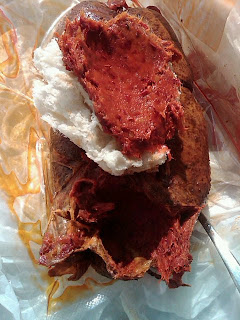
And, being salty and spicy in an extreme way the nduja begged for something sweet. Luckily I had an grotesquely large apple obtained from the same Mercato Centrale where I procured the fatty spread.

The previous night I had the pleasure of dining with some friends at a lovely modern Italian restaurant where we were treated to fresh riccioli tossed with warmed nduja. As a sauce for pasta, it is peerless.

Why the play by play you might ask? Normally this blog is babbles rather than bullet lists...
I feel compelled to share. What may simply seem like lunch is actually one of those rare travel experiences that set a benchmark for all others. For some folks it's ancient basilicas or bungee jumping. For me it happens to be edible culture. Nduja is a DOP product, which essentialy means it's name and character are protected by the Italian government (my definition, not nearly detailed enough, I know!) I can scarf salami and pack away prosciutto until I bleed grease, but that is more or less something I can do anywhere. Access to a native food I rarely see, a cultural culinary icon so to speak, of a small region or town tucked away in the hills - that is a memory to frame my whole experience with. I've spoken before of context and how important it is to the enjoyment of great food. I think the contextual implications of finding such a product while here in Italy - so fresh, so close to the source - speak for themselves.
I visited Florence once before, many years ago. With all the locales I've been to recently, it occured to me as I rolled into Santa Maria Novella train station that this is the first place I am revisiting. Over ten years in between has rendered me a completely different person, able to appreciate being here in different ways. It's a rare treat to be able to visit someplace so far from home not once, but twice or maybe even more. New discoveries, experiences and meat based products lie in wait each time you arrive. The context in which you enjoy and appreciate a city or place changes and evolves as you do. In the professional kitchen, we trudge through the same service day in and day out. Prep the same food, fire the same orders and wash the same dishes. Yet it's different each time, isn't it? That is what I have always loved about working in restaurants. The layer of monotony is only skin deep. Under the surface are new perspectives, contexts and situations each and every day. Years and years down the road, life in the kitchen can still keep you guessing and you can trudge through it knowing that tomorrow will most likely bring some sort of new surprise.
I wasn't sure I would make it to Italy. When I arrived here I had visions of going to all the places I missed last time around. As circumstances would have it, I will mainly haunt the two cities I have already spent time in once before long ago - Florence and Rome - before I leave. The disappointment I feel for not having more time and money to explore is almost fully offset by the excitement of all the new layers I will discover this second time around.
Many people figure they can put off travel until the golden years. A grave mistake. Do it now. Do it often. And then do it again...