Showing posts with label meat. Show all posts

Wednesday, September 29, 2010

Nduja!

My trusty Timbuk2 messenger bag reeks of the sweetness that only salted flesh and fat can devise. For weeks now I've been picnicing with various cured meats and cheeses from myriad European markets, but here and now in Italy the sheer meaty madness has reached it's zenith. Yesterday it was lardo that I paired with a succulent walnut sauce meant for pasta, but equally fulfilling as a dip for fat wrapped Tuscan bread. Today though, is a treat the likes of which you don't stumble on every day. Most great Italian cured meats are widely available in the U.S. either as imported products or domestic representations. I've made plenty of them in my capacity as both a chef and hobbyist. Like any import though, some of the true gems don't readily make it out of the homelad. Today I have ripening in my bag as I trudge the streets of Firenze the Calabrian specialty: Nduja (in-doo-ya). Similar to salami only in that it's made from ground pork, heavily spiced and salted, and stuffed into intestinal casing to be smoked and aged; nduja is soft and spreadable. Native to Calabria it has a characteristic firey pepper flavor. Don't let it's bladderesque appearence fool you...this is an epic treat for someone as geeky as myself.

Heretoforth, I had only indulged in nduja (say that five times fast!) once. As far as I know there is only one place in the United States producing this product and I can now attest having had it in the homeland that their's is an exemplary recreation, true to form and flavor in every way. Boccalone of the Ferry Building in San Francisco brought nduja to my attention when Chris Cosetino and Co. started producing it not too long ago. I was lucky enough to sneak a taste when I passed through SF and was impressed to say the least. Stumbling upon it in Florence - not technically where it is produced - was a welcomed accident. I picniced in one of many Florentine piazzas with some bread:
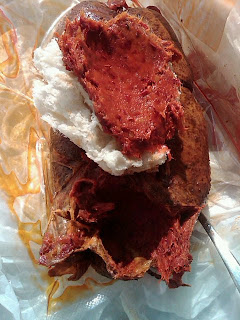

And, being salty and spicy in an extreme way the nduja begged for something sweet. Luckily I had an grotesquely large apple obtained from the same Mercato Centrale where I procured the fatty spread.


The previous night I had the pleasure of dining with some friends at a lovely modern Italian restaurant where we were treated to fresh riccioli tossed with warmed nduja. As a sauce for pasta, it is peerless.

Why the play by play you might ask? Normally this blog is babbles rather than bullet lists...

I feel compelled to share. What may simply seem like lunch is actually one of those rare travel experiences that set a benchmark for all others. For some folks it's ancient basilicas or bungee jumping. For me it happens to be edible culture. Nduja is a DOP product, which essentialy means it's name and character are protected by the Italian government (my definition, not nearly detailed enough, I know!) I can scarf salami and pack away prosciutto until I bleed grease, but that is more or less something I can do anywhere. Access to a native food I rarely see, a cultural culinary icon so to speak, of a small region or town tucked away in the hills - that is a memory to frame my whole experience with. I've spoken before of context and how important it is to the enjoyment of great food. I think the contextual implications of finding such a product while here in Italy - so fresh, so close to the source - speak for themselves.

I visited Florence once before, many years ago. With all the locales I've been to recently, it occured to me as I rolled into Santa Maria Novella train station that this is the first place I am revisiting. Over ten years in between has rendered me a completely different person, able to appreciate being here in different ways. It's a rare treat to be able to visit someplace so far from home not once, but twice or maybe even more. New discoveries, experiences and meat based products lie in wait each time you arrive. The context in which you enjoy and appreciate a city or place changes and evolves as you do. In the professional kitchen, we trudge through the same service day in and day out. Prep the same food, fire the same orders and wash the same dishes. Yet it's different each time, isn't it? That is what I have always loved about working in restaurants. The layer of monotony is only skin deep. Under the surface are new perspectives, contexts and situations each and every day. Years and years down the road, life in the kitchen can still keep you guessing and you can trudge through it knowing that tomorrow will most likely bring some sort of new surprise.

I wasn't sure I would make it to Italy. When I arrived here I had visions of going to all the places I missed last time around. As circumstances would have it, I will mainly haunt the two cities I have already spent time in once before long ago - Florence and Rome - before I leave. The disappointment I feel for not having more time and money to explore is almost fully offset by the excitement of all the new layers I will discover this second time around.

Many people figure they can put off travel until the golden years. A grave mistake. Do it now. Do it often. And then do it again...


Saturday, September 4, 2010

Challenge Yourself To Fail

I always figured without putting much thought into it that an endless array of cured meats and cheeses would be something like paradise for me. Salted and smoked, curdled and aged, preserved for future sustenance while also creating a whole new universe of flavorful possibilities. The Dolac Market in Zagreb, Croatia has a selection of dried out animal parts large enough to make any butcher blush, with an equally impressive abundance of dairy. Primarily an outpost for fresh fruit and vegetables, the juxtaposition of fresh and preserved is not lost on me. For as long as humans have grown fresh food and raised livestock there has been a need to eat now while saving some for later, two halves of the same circle that meet in the market place. With all of it at my fingertips here in Zagreb, my paradise becomes a purgatory of indecision. Where to start, how to end, and what possibly to leave out don't seem like questions I will readily be able to answer. Fortunately I'm purchasing for two...meals that is. The selection widens. I grab some plums so ripe they taste like skin covered jam. Some bread to act as a vehicle for my meaty debauchery. Then I book another night at the hostel. I'll need an extra day to go back for the cheeses...

I've been taking advantage of the markets lately, especially as I move further into Europe. There have been markets like this throughout most of my travels, but for a while I was happily stuck on the quest of sampling each and every delicacy that could be prepared for me. To be honest, I was happy not doing any cooking for the time being. Seasons change, though and my urge to grab everything I see and run to a kitchen is back. I think it all started with the fresh shell beans I saw in Mostar, Bosnia. Actually, I had seen shell beans for sale a few times before that, but in Mostar I was staying in a quiet little hostel with a kitchen at my disposal. It's a touristy little town with not much but overpriced restaurants, so I was already in the frame of mind to save some money when I stumbled upon an assorted sack of peeled fresh beans for a pittance. Not more than two dollars for something that would have cost me much much more at an American farmer's market. It has occurred to me with intrigue and a little sadness that while fresh, local organics in America are at their height of popularity, they are inescabaply still a novelty. What I mean to say is that we still treat it as special, and as a result pay a premium for what is minimally processed food and should actually cost less, because no fertilizers or expensive pesticides go into it. I'm not suggesting any sort of trickery from the farmer who sells us these unadultered foods. Rather I am hypothesiying that we as consumers have created an economy in which mass produced foods which don't taste as good and carry chemical components uneccesary to our survival (while depositing them in the earth as well), are cheaper because we purchase them with such voracity, upending the scales of economy for those who do things the old fashioned way. They need to charge more not because the product cost extra to produce, but because they simply don't have enough customers to compete. An image has been created largely by our own doing, that organic foods are somehow premium and should cost accordinly, rather than just normal with a normal price, being consumed normally by everyone all the time. Here in Croatia and other places I've visited recently most food is purchased at daily greenmarkets, the type we only have once or twice a week in America but they have every day, year round. The prices are rock bottom too, in line with the income of average people. One can literally eat like a king, without having to fork over a king's ransom.

The access to outstanding raw ingredients has proven irressistable, so I have been making the effort to shop at these greenmarkets and cook. When there is no access to a kitchen I work with whatever I can raw. There is certainly no end to the possibilities with all I have to choose from and the unparalleled quality. Grabbing those shell beans along with some other odds and ends caused me to think back to the days when I had first moved to Portland. I started cooking seriously for the first time in my life and wanted to expand my repetoire. Work helped, but I needed to stretch out into territory that for me, was yet to be discovered. I got into the habbit of swinging by an Asian grocery about once a week and buying something I had never cooked with before. A gristly cut of meat or offal, a strange vegetable or some sort of starch I may have seen mentioned in an article somewhere. These day off excursions usually followed similar paths that ended in complete and utter dissapointment. I never stopped to do the research or consult a recipe. I would simply jump in head first, blindly feeling my way towards ruining a days worth of work. But how ruined am I for it? How much time was wasted? None at all, it turns out. Sure, I learned a million and one ways not to do things, but more importantly than that I aquired little by little a knowledge of how food works. How this and that react to heat. How well things do and don't go together. How much is too much or too little. Slowly each blunder revealed it's silver lining and gave way to mini triumphs. It turns out all that time I thought was just messing around actually took me some place new. I was thinking about all that when I threw my beautiful shell beans into an aluminum pot with water and some other vegetables and turned on the heat. The kitchen I was in had no oil to saute with, no spices or herbs to use, no dairy fridge or stash of bacon ends and fat back. In fact, if one of the other guests in the hostel had not been a smoker, I would not even have been able to light the stove. I was left alone with nothing but honest, local, organic ingredients which cost me next to nothing. I fed eveyone hanging around that night and tried to explain that the ingredients had done most of the work. It was the instinct aquired through hundreds of experiments destined for the bottom of a trash bag that had guided what order I threw it all into the pot and how long I let is simmer for. I think to cook professionally one needs to have that feeling of a hundred failures under the belt. How can you understand the degrees of success if you have never seen the other side of the coin. It's important to get out of your comfort zone if you ever expect to move forward in life. In a way, that is what each of my little kitchen experiments was about. Progressing from line cook to chef was a major leap out of my comfort zone, and leaving that job and the city I lived in to travel indeffinitely with barely any plans was yet another jump into the uncomfortable. In every instance I've been able to adapt and progress through making a series of awfully stupid and silly mistakes. Mistakes I learn from and that make me more confident. Each place I visit brings a new greenmarket with local ingredients to toss in a pot and remind myself again how I got here and how I can get to the next place I'm going.


Monday, August 23, 2010

How much is too much grilled meat?

I had arrived in Nis (pronounced: nish), Serbia after a long day of bumpy bus rides from Bitola in the south of Macedonia. I did the obligatory exploring of my surroundings before tucking into the task of finding dinner. Searching out the first meal in a new place can be exciting while at the same time a little tense. The initial sampling of local fare sets the tone for my visit. It is the all important first impression, the one that can never be had again. Much like the opening track on an album or the first lines of any great novel I need to be grabbed by what I eat first, leaving me both figuratively and literally hungry for more. Could this be the best of meals or the worst of meals? While it may seem like I set the bar high, the truth is that I have a delicate ritual for finding sustenance, borne out of the mortal fear that one of my feedings will be anything less than spectacular. Perhaps more a habitual indecision in the guise of academic selection than a ritual, I find myself looking, rejecting and repeating until I feel a sound decision can be made on what to consume. It happens multiple times daily, but the first in a new place always takes on an air or importance the others lack. I've heard people say that there exist two types of people. Those who eat to live and those who live to eat. Dismissing for a moment how obtuse one would be to believe humanity can fit neatly into two groups, I'd have to say that on this one I fall dead center into the "live to eaters." Swish! Nothing but net!

On this evening in Nis, I encountered a promising situation not far from the hostel I was calling home for the next couple of nights. Out of principle I never shoot for the first meat I see, but never rule out doubling back for the kill. Nis is a university city and I found myself on the edge of a sprawling outdoor athletic complex slash idyllic urban park. It stands to reason that more treasures would be available around each corner, what with thousands of college age coeds about. What I had seen, made note of and passed by was a row of roadside stands grilling all sorts animal parts that would seem to fit well into sandwiches. Each stand identical as though they were squeezed like Play Dough through a mold and then chopped into sole proprietorships, they boasted a grill set in a bay window so you could watch the action, and then a separate window with refrigerated display case of various vegetables and dressing that incidentally also seemed fit to be stuffed into a sandwich. While my search for more options is under the pretense of academic investigation, there is an underlying fear that I might miss something good. That's what it comes down to. I want it all. I have this recurring nightmare where I'm telling a group of people who know my love of all things edible that I visited this city or that and one smug fellow says, "Did you try the such and such? You shan't have missed it!" He slaps me on the back with a sigh and haughtily says, "Well, there's always next time." I can't bare the thought of missing out on something great. After an exhaustive search of the area accessible by foot, I made my way back to the original source of intrigue.

As of late, conquering each and every secret that a city has to offer has become a tad more nuanced. Grilled meat and bread is a beloved theme throughout Turkey and the Balkans. The differences are subtle from place to place, and if you blink one might just pass you by. Turkey is all about the doner. Lamb or chicken piled high and wide on a skewer, held vertically and slowly roasted while rotating. It's an image I'm sure most have seen. Meat is sliced off thin and wrapped in pita. In Anatalya, I stumbled on wood fired doner kebap, which was every bit as smoky and delicious as it sounds. Unique to Turkey and my favorite by far is kokorech. Made by wrapping lamb intestines around more lamb intestines, and spit roasting the whole wonderful mess. They slice some of the lamb tummy roulade, chop it up and make a sandwich. Never have I filled my stomach with so much stomach. In Greece, the gyro is ubiquitous. It's doner kebap made with pork and if done right has some french fries stuffed in the mix. If you take it to go instead of sitting down it's half the price, plus you can walk to a park or church yard and be alone with it. Macedonia had an eclectic mix of grilled items. I sampled among other things, thinly sliced calf's liver drowned in olive oil and chopped herbs and pork loin stuffed with cheese and then wrapped in prosciutto. And bread, always bread. It seems the further north I go the the thicker the pita gets. In Macedonia it's like throw pillows. Always super fresh and crusty like only a brick oven could make it. Nis marked my first stop in Serbia, and the regional variation I stumbled on first is pljeskavica, or Balkan Burgers.

While myriad meats are on display in the grilling windows, the thin and wide burger patties are the what people pine for. Since I can't read the menu, ordering is altogether and exasperating and yet exciting experience that involves a plethora of pointing, gestures and quietly spoken English, more to remind myself what hand motions I should be making. I had inhaled a chicken thigh monstrosity of a sandwich before I understood that the pljeskavica is the main event. I had also noted that down the way was a grill spot that had a long line while the others served one or none at all. Here in lies a difficult decision. Do I waste one of tomorrow's meals - or opportunity for mind altering edible discovery, as I like to call it - by coming back to the popular spot, or do I man up and have a second dinner right now. I went back and forth on the issue, but I think you can all guess which direction I ultimately went in.

Later that night, unable to move or even breathe properly, I pondered the impossibility of having it all, of trying everything there is to be tried. As much as I loathe to admit, one cannot do everything, go everywhere and turn over every stone. There are choices to be made and inevitably if you are tuned into the proper frequencies, eyes wide open, then one will lead to the next. Attempting to go in every direction will tear you apart, in a sense. So will trying to eat every heaping pile of grilled meat in the Balkans. It is nice to look back and remember how each job in the restaurant industry I've had has led to the next. Realization of new skills and interests or even a chance meeting can open up doors to new experiences in a world where people tend to stay moving from post to post. Right now, not completely sure in what capacity I'd like to reenter the work force, I am trying to keep focus on figuring out what conditions will truly satisfy me, rather than considering everything in my path. The past, while opening up doors to the future should also send you on you way with the knowledge to succeed wherever you end up. In that sense all our jobs in this industry are connected, from executive dishwasher on up to executive chef. As I approach whatever may be next in my career I will definitely pick and choose with a discerning eye, but search with the same vigor and intensity that I devote to that integral first meal in each new place I visit.