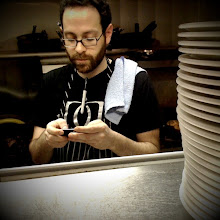
I've learned a thing or two about a thing or two these past months on the move. Some of the lessons are not so new, but certainly illustrated in a different context than I recognized previously. Rather, instead of lessons let us refer to these as points of interest that apply to my life traveling extensively -on a budget- but are inextricably related to my life as a professional "food cooker" (title coined in the broken English of a jovial German bloke I met). These tid-bits and truisms are no more than silly observations I've made, most of them no doubt in a moment of utter folly on my part, but they join none the less to many aspects of life because, as I've always believed there are connections to be seen in the meaningless jumble so long as you take the sage advice of that visionary Bill Hicks, and squeegee your third eye (paraphrased and used to fit my own analogy - Thanks Bill!). So, I've compiled a list of twenty-three petite epiphanies experienced while traveling that relate directly to being a professional food cooker and maybe not so direct to other things. Why 23? No reason that I can think of....
Always do your conversions ahead of time. Weights, volumes, distance and especially currency.
Getting lost can lead to the most worthwhile discoveries, but it is important to recognize when you are about to cross into the realm of being hopelessly lost, and turn back.
This is not all fun and games (and getting lost)! Managing costs is central to continuing the show. Master it.
As a tourist you can flit from attraction to attraction in a city or really explore it, get to know it and "take it's pulse" so to speak. If you don't dig in, then you haven't really been there.
Have a tasting spoon with you at all times...
Make sure you keep your eye on the big picture. Why am I here? What do I want to walk away with? But don't focus so intently on it you loose sight of the small, unexpected details as they pass by.
Screwups are unavoidable. Don't repeat them.
Always have a quality, comfortable pair of shoes.
The simplest route to your next destination is usually the best.
Pork is simply the undisputed champion of meat worldwide...hands down!
Maps...recipes...kinda the same thing. Everyone has their own approach and it can be a polarizing topic. All I can say is, make sure you've got one handy, just in case.
Technology makes life easier and can enhance your experience. Use it, but don't be consumed by it.
There is always time for a coffee break.
Frustrating situations are inevitable. How you deal with them makes all the difference.
You get what you pay for.
Fresh food markets are fascinating and not to be missed. Fresh and seasonal fruits and vegetables are central to understanding where you are and how people there live, eat and love.
Don't take anything - especially yourself - too seriously.
Only bring what you can carry. Don't bring what you can't afford to loose.
Getting angry and yelling at people who don't speak your language is an exercise in futility.
Seeing grandeur day after day may get monotonous once in a while, but that doesn't make it any less magical.
More fancy and expensive gear doesn't make you better at what you do.
There is a reason why some things and places are "touristy." Don't forswear that which has been proven through time and trial just for the sake of being different. It will be your loss.
Planning is overrated. The perils of not planning are understated.
Showing posts with label markets. Show all posts
Showing posts with label markets. Show all posts
Thursday, October 14, 2010

Saturday, September 4, 2010
Challenge Yourself To Fail
I always figured without putting much thought into it that an endless array of cured meats and cheeses would be something like paradise for me. Salted and smoked, curdled and aged, preserved for future sustenance while also creating a whole new universe of flavorful possibilities. The Dolac Market in Zagreb, Croatia has a selection of dried out animal parts large enough to make any butcher blush, with an equally impressive abundance of dairy. Primarily an outpost for fresh fruit and vegetables, the juxtaposition of fresh and preserved is not lost on me. For as long as humans have grown fresh food and raised livestock there has been a need to eat now while saving some for later, two halves of the same circle that meet in the market place. With all of it at my fingertips here in Zagreb, my paradise becomes a purgatory of indecision. Where to start, how to end, and what possibly to leave out don't seem like questions I will readily be able to answer. Fortunately I'm purchasing for two...meals that is. The selection widens. I grab some plums so ripe they taste like skin covered jam. Some bread to act as a vehicle for my meaty debauchery. Then I book another night at the hostel. I'll need an extra day to go back for the cheeses...
I've been taking advantage of the markets lately, especially as I move further into Europe. There have been markets like this throughout most of my travels, but for a while I was happily stuck on the quest of sampling each and every delicacy that could be prepared for me. To be honest, I was happy not doing any cooking for the time being. Seasons change, though and my urge to grab everything I see and run to a kitchen is back. I think it all started with the fresh shell beans I saw in Mostar, Bosnia. Actually, I had seen shell beans for sale a few times before that, but in Mostar I was staying in a quiet little hostel with a kitchen at my disposal. It's a touristy little town with not much but overpriced restaurants, so I was already in the frame of mind to save some money when I stumbled upon an assorted sack of peeled fresh beans for a pittance. Not more than two dollars for something that would have cost me much much more at an American farmer's market. It has occurred to me with intrigue and a little sadness that while fresh, local organics in America are at their height of popularity, they are inescabaply still a novelty. What I mean to say is that we still treat it as special, and as a result pay a premium for what is minimally processed food and should actually cost less, because no fertilizers or expensive pesticides go into it. I'm not suggesting any sort of trickery from the farmer who sells us these unadultered foods. Rather I am hypothesiying that we as consumers have created an economy in which mass produced foods which don't taste as good and carry chemical components uneccesary to our survival (while depositing them in the earth as well), are cheaper because we purchase them with such voracity, upending the scales of economy for those who do things the old fashioned way. They need to charge more not because the product cost extra to produce, but because they simply don't have enough customers to compete. An image has been created largely by our own doing, that organic foods are somehow premium and should cost accordinly, rather than just normal with a normal price, being consumed normally by everyone all the time. Here in Croatia and other places I've visited recently most food is purchased at daily greenmarkets, the type we only have once or twice a week in America but they have every day, year round. The prices are rock bottom too, in line with the income of average people. One can literally eat like a king, without having to fork over a king's ransom.
The access to outstanding raw ingredients has proven irressistable, so I have been making the effort to shop at these greenmarkets and cook. When there is no access to a kitchen I work with whatever I can raw. There is certainly no end to the possibilities with all I have to choose from and the unparalleled quality. Grabbing those shell beans along with some other odds and ends caused me to think back to the days when I had first moved to Portland. I started cooking seriously for the first time in my life and wanted to expand my repetoire. Work helped, but I needed to stretch out into territory that for me, was yet to be discovered. I got into the habbit of swinging by an Asian grocery about once a week and buying something I had never cooked with before. A gristly cut of meat or offal, a strange vegetable or some sort of starch I may have seen mentioned in an article somewhere. These day off excursions usually followed similar paths that ended in complete and utter dissapointment. I never stopped to do the research or consult a recipe. I would simply jump in head first, blindly feeling my way towards ruining a days worth of work. But how ruined am I for it? How much time was wasted? None at all, it turns out. Sure, I learned a million and one ways not to do things, but more importantly than that I aquired little by little a knowledge of how food works. How this and that react to heat. How well things do and don't go together. How much is too much or too little. Slowly each blunder revealed it's silver lining and gave way to mini triumphs. It turns out all that time I thought was just messing around actually took me some place new. I was thinking about all that when I threw my beautiful shell beans into an aluminum pot with water and some other vegetables and turned on the heat. The kitchen I was in had no oil to saute with, no spices or herbs to use, no dairy fridge or stash of bacon ends and fat back. In fact, if one of the other guests in the hostel had not been a smoker, I would not even have been able to light the stove. I was left alone with nothing but honest, local, organic ingredients which cost me next to nothing. I fed eveyone hanging around that night and tried to explain that the ingredients had done most of the work. It was the instinct aquired through hundreds of experiments destined for the bottom of a trash bag that had guided what order I threw it all into the pot and how long I let is simmer for. I think to cook professionally one needs to have that feeling of a hundred failures under the belt. How can you understand the degrees of success if you have never seen the other side of the coin. It's important to get out of your comfort zone if you ever expect to move forward in life. In a way, that is what each of my little kitchen experiments was about. Progressing from line cook to chef was a major leap out of my comfort zone, and leaving that job and the city I lived in to travel indeffinitely with barely any plans was yet another jump into the uncomfortable. In every instance I've been able to adapt and progress through making a series of awfully stupid and silly mistakes. Mistakes I learn from and that make me more confident. Each place I visit brings a new greenmarket with local ingredients to toss in a pot and remind myself again how I got here and how I can get to the next place I'm going.

I've been taking advantage of the markets lately, especially as I move further into Europe. There have been markets like this throughout most of my travels, but for a while I was happily stuck on the quest of sampling each and every delicacy that could be prepared for me. To be honest, I was happy not doing any cooking for the time being. Seasons change, though and my urge to grab everything I see and run to a kitchen is back. I think it all started with the fresh shell beans I saw in Mostar, Bosnia. Actually, I had seen shell beans for sale a few times before that, but in Mostar I was staying in a quiet little hostel with a kitchen at my disposal. It's a touristy little town with not much but overpriced restaurants, so I was already in the frame of mind to save some money when I stumbled upon an assorted sack of peeled fresh beans for a pittance. Not more than two dollars for something that would have cost me much much more at an American farmer's market. It has occurred to me with intrigue and a little sadness that while fresh, local organics in America are at their height of popularity, they are inescabaply still a novelty. What I mean to say is that we still treat it as special, and as a result pay a premium for what is minimally processed food and should actually cost less, because no fertilizers or expensive pesticides go into it. I'm not suggesting any sort of trickery from the farmer who sells us these unadultered foods. Rather I am hypothesiying that we as consumers have created an economy in which mass produced foods which don't taste as good and carry chemical components uneccesary to our survival (while depositing them in the earth as well), are cheaper because we purchase them with such voracity, upending the scales of economy for those who do things the old fashioned way. They need to charge more not because the product cost extra to produce, but because they simply don't have enough customers to compete. An image has been created largely by our own doing, that organic foods are somehow premium and should cost accordinly, rather than just normal with a normal price, being consumed normally by everyone all the time. Here in Croatia and other places I've visited recently most food is purchased at daily greenmarkets, the type we only have once or twice a week in America but they have every day, year round. The prices are rock bottom too, in line with the income of average people. One can literally eat like a king, without having to fork over a king's ransom.
The access to outstanding raw ingredients has proven irressistable, so I have been making the effort to shop at these greenmarkets and cook. When there is no access to a kitchen I work with whatever I can raw. There is certainly no end to the possibilities with all I have to choose from and the unparalleled quality. Grabbing those shell beans along with some other odds and ends caused me to think back to the days when I had first moved to Portland. I started cooking seriously for the first time in my life and wanted to expand my repetoire. Work helped, but I needed to stretch out into territory that for me, was yet to be discovered. I got into the habbit of swinging by an Asian grocery about once a week and buying something I had never cooked with before. A gristly cut of meat or offal, a strange vegetable or some sort of starch I may have seen mentioned in an article somewhere. These day off excursions usually followed similar paths that ended in complete and utter dissapointment. I never stopped to do the research or consult a recipe. I would simply jump in head first, blindly feeling my way towards ruining a days worth of work. But how ruined am I for it? How much time was wasted? None at all, it turns out. Sure, I learned a million and one ways not to do things, but more importantly than that I aquired little by little a knowledge of how food works. How this and that react to heat. How well things do and don't go together. How much is too much or too little. Slowly each blunder revealed it's silver lining and gave way to mini triumphs. It turns out all that time I thought was just messing around actually took me some place new. I was thinking about all that when I threw my beautiful shell beans into an aluminum pot with water and some other vegetables and turned on the heat. The kitchen I was in had no oil to saute with, no spices or herbs to use, no dairy fridge or stash of bacon ends and fat back. In fact, if one of the other guests in the hostel had not been a smoker, I would not even have been able to light the stove. I was left alone with nothing but honest, local, organic ingredients which cost me next to nothing. I fed eveyone hanging around that night and tried to explain that the ingredients had done most of the work. It was the instinct aquired through hundreds of experiments destined for the bottom of a trash bag that had guided what order I threw it all into the pot and how long I let is simmer for. I think to cook professionally one needs to have that feeling of a hundred failures under the belt. How can you understand the degrees of success if you have never seen the other side of the coin. It's important to get out of your comfort zone if you ever expect to move forward in life. In a way, that is what each of my little kitchen experiments was about. Progressing from line cook to chef was a major leap out of my comfort zone, and leaving that job and the city I lived in to travel indeffinitely with barely any plans was yet another jump into the uncomfortable. In every instance I've been able to adapt and progress through making a series of awfully stupid and silly mistakes. Mistakes I learn from and that make me more confident. Each place I visit brings a new greenmarket with local ingredients to toss in a pot and remind myself again how I got here and how I can get to the next place I'm going.

Tuesday, April 20, 2010
Where's the beef?!?
It will shock everyone reading this, I'm sure, to learn that that my initial motivation for visiting Vietnam was to eat soup. A close second priority was eating baguette sandwiches. Vietnam is a country rich with history and culture, some of which is poignantly entwined with that of the U.S. Over the years, hundreds of thousands of Vietnamese people have emigrated to various communities in the United States and brought a delicious culinary tradition along with them. In cities I have been happy to call home, most recently Portland, little Vietnamese noodle and/or sandwich shops are prolific. I spent a great deal of my free time over the past two years occupying corner tables of these spots with a book and a steaming bowl of noodle soup accented with various cuts of beef, or perhaps a pig knuckle or two. Naturally, I figured that if the native cuisine could be so enjoyable in America it would be more so on it's home turf. I also assumed it would be everywhere. Back home of course I had to trek over to the Vietnamese area of town to get my fix. In Vietnam I would have the geographical advantage of always being in the Vietnamese area of town. Score! Right...?
Not exactly. It was a persistent and annoying theme of my two weeks in Vietnam to be searching far and wide for something interesting to eat. I'm always willing to tough out hunger until I find the perfect meal, but it started to get ridiculous after a while. In Thailand food is everywhere! There is no end to the variety of new and interesting things to eat. Vietnam started out decidedly less exciting. I would set out to find a meal and instead of spending my time narrowing down the vast selection, I would have to walk further and further just to find a roadside stand serving up anything at all. By the time something came up I would generally give it a try, not wanting to risk walking even further down the maze of alley ways searching for food that might not be there. The crushing part of this picture is that the version of Pho Bo, the Vietnamese dish most widely represented in America, I would find never lived up to what I am accustomed to. Recreations of Pho Bo - beef noodle soup - in America are usually adorned with a variety of beef cuts including but not limited to flank, eye of round, fatty brisket and my personal favorite: tripe. All of this in a rich meaty broth, served with a side plate of bean sprouts and various herbs to garnish with. In the homeland, the best I received was often watery with stringy shavings of unidentifiable beef trimmings, no garnishes and nary a morsel of tripe. I had a few classic, "where's the beef?" moments. My expectations smashed, I would move on to the next, hoping it would be better. Perhaps I built things up too much in my head before arriving. My initial image of Vietnamese food in Vietnam may look depressing, but what kind of blog post would this be if I weren't able to put some sort of positive spin on the situation. Am I not the same person who can look back fondly on two years of capping twelve hour work days by washing dishes late into the night? There's got to be a silver lining, even if you have to work with the scouring pad a little to find it.
The longing left by a few disappointing food finds created unique opportunity for me to be dazzled by some unexpected discoveries. Thailand was monumental, but too easy. Vietnam proved to be more difficult but ultimately more rewarding at the same time. The first milestone was in Sapa, a mountain resort town way in the north. It was my first real stop in the country after four rugged days of bus travel (see previous post). Sapa had way too many "western themed" restaurants and even what was touted as local cuisine seemed over priced and underwhelming. That is until I found the food market. I love walking through Asian versions of what we would call a Farmer's Market in America. Endless rows of fresh fruits, vegetables, fish and meats. The meats especially are something to behold. Far from the pristine and packaged versions we are used to, Asian markets usually have entire carcasses on display and overflowing bins of offal. It's a truly unabashed and unashamed display of carnivorous glory and what I love about it most is that it's totally normal. There is no cultural stigma involved with enjoying meat and accepting what it is and where it comes from. No one is afraid or finicky about eating what nature has provided. Nothing gets wasted and the eating experience is richer and more fulfilling as a result. In the market's equivalent of a food court, there were numerous vendors preparing a version of chicken soup that seemed custom fit to me, specifically. Egg laying hens, which are also used for meat in Asia, always have a few eggs still in production when slaughtered. It amounts to nothing more than a yolk without white or shell, that is extracted along with all the other innards. The soup I had came garnished with a few of these yolks lightly boiled along with the noodles, deeply flavored broth, shredded meat and fresh herbs. Truly unforgettable!
In Hue, an ancient capital city that was horribly bombed during the Vietnam war I walked with a few other people for a while through staggering heat and humidity to track down a noodle stall that was marked on a tourist map we had been given. Not sure what to expect, we found a roadside stall that didn't look like much, but was the only thing there. We opted in, and while waiting for the soup to arrive I noticed the bowl of quail eggs on the table along with the usual suspects of chilis and fish sauce. There was also something wrapped in a banana leaf. Next, I realized what all the hype was over. Three old ladies were crouching around a pot of boiling broth cutting rice noodles by hand from a fresh made dough. This amounted to the best Vietnamese soup I've had to date, hands down. Fresh, toothsome rice noodles in a light fish broth, garnished with quail eggs I peeled myself at the table and a fine ground pork pate, which is the gift that was hiding inside the banana leaves. There are so many different attitudes and mentalities that go into preparing food for others, but as I've noted before there are elements of pride and passion that can't be acted out. They're either real or not there at all. Watching those ladies chip away noodles - which they do night after night for the masses of local folks who were lining up as I sipped steaming soup in 90 degree heat - I knew I was witnessing undeniable pride in action. It's a common ingredient in great food no matter what or where you are in the world.
There were others as well. Also in Hue, I stumbled upon a stand serving slow simmered beef and rice soup. I had some along with the water from an enormous coconut while losing half my weight in perspiration. How the locals eat hot soup in that heat regularly is beyond me. The gaggle of ladies sitting nearby mistook my sweating for inability to handle the spiciness, and ran over to fan me off, laughing incessantly the whole time. It's difficult to fathom how stupid I looked sweating out that soup quicker than I could eat it while hoisting a basketball sized coconut to my lips every so often. No matter how hard I try not to look like a tourist, there are moments like this one where I fail miserably. In Hoi An, I finally found the baguette sandwiches I covet so much. I went back daily and carried one to my favorite sugar cane juice vendor right along the river and would sit there for a while, escaping the heat and excessive commercialism. All of this was prelude to Ho Chi Minh City - aka Saigon - where I sadly stayed for only one day. As it turns out, Saigon is the answer to the title question. It's all there! The soup, the sandwiches and much more are lining the streets of HCMC, with endless variety and opportunity to eat. I indulged in as much as I could with limited time. I ate fresh steamed snails with black pepper and lime, and enjoyed embryonic duck eggs and Tiger Beer while talking to a man who moved from Saigon to Texas after the war, but was back visiting family. He left because the country wasn't safe for members of the South Vietnamese Army back then. Things are different now, though. America and Vietnam established diplomatic relations in 1995, and although there is still justified animosity concerning the atrocities commited, people I met embrace Americans with open arms. I was approached by numerous people both young and old over two weeks there who wanted to practice their English and learn about America. They all hope to travel there some day, and hope for more Americans to visit their country. I was surprised at first, because other travelers had given me mixed reviews of how they had ben received in Vietnam. Getting a visa to visit was considerably more difficult than entering other countries in the region. All the drama leading up to my actual arrival set the stage for an awkward stay, but it stands to reason that sometimes an arduous journey offers a more satisfying reward. The hidden culinary gems I found far exceeded my expectations even if the day to day dining did not. In the same respect, people I met and spoke with more than made up for the visa application frustrations and bumpy bus rides. I departed Vietnam already plotting the route for my next visit, whenever that may be.
Not exactly. It was a persistent and annoying theme of my two weeks in Vietnam to be searching far and wide for something interesting to eat. I'm always willing to tough out hunger until I find the perfect meal, but it started to get ridiculous after a while. In Thailand food is everywhere! There is no end to the variety of new and interesting things to eat. Vietnam started out decidedly less exciting. I would set out to find a meal and instead of spending my time narrowing down the vast selection, I would have to walk further and further just to find a roadside stand serving up anything at all. By the time something came up I would generally give it a try, not wanting to risk walking even further down the maze of alley ways searching for food that might not be there. The crushing part of this picture is that the version of Pho Bo, the Vietnamese dish most widely represented in America, I would find never lived up to what I am accustomed to. Recreations of Pho Bo - beef noodle soup - in America are usually adorned with a variety of beef cuts including but not limited to flank, eye of round, fatty brisket and my personal favorite: tripe. All of this in a rich meaty broth, served with a side plate of bean sprouts and various herbs to garnish with. In the homeland, the best I received was often watery with stringy shavings of unidentifiable beef trimmings, no garnishes and nary a morsel of tripe. I had a few classic, "where's the beef?" moments. My expectations smashed, I would move on to the next, hoping it would be better. Perhaps I built things up too much in my head before arriving. My initial image of Vietnamese food in Vietnam may look depressing, but what kind of blog post would this be if I weren't able to put some sort of positive spin on the situation. Am I not the same person who can look back fondly on two years of capping twelve hour work days by washing dishes late into the night? There's got to be a silver lining, even if you have to work with the scouring pad a little to find it.
The longing left by a few disappointing food finds created unique opportunity for me to be dazzled by some unexpected discoveries. Thailand was monumental, but too easy. Vietnam proved to be more difficult but ultimately more rewarding at the same time. The first milestone was in Sapa, a mountain resort town way in the north. It was my first real stop in the country after four rugged days of bus travel (see previous post). Sapa had way too many "western themed" restaurants and even what was touted as local cuisine seemed over priced and underwhelming. That is until I found the food market. I love walking through Asian versions of what we would call a Farmer's Market in America. Endless rows of fresh fruits, vegetables, fish and meats. The meats especially are something to behold. Far from the pristine and packaged versions we are used to, Asian markets usually have entire carcasses on display and overflowing bins of offal. It's a truly unabashed and unashamed display of carnivorous glory and what I love about it most is that it's totally normal. There is no cultural stigma involved with enjoying meat and accepting what it is and where it comes from. No one is afraid or finicky about eating what nature has provided. Nothing gets wasted and the eating experience is richer and more fulfilling as a result. In the market's equivalent of a food court, there were numerous vendors preparing a version of chicken soup that seemed custom fit to me, specifically. Egg laying hens, which are also used for meat in Asia, always have a few eggs still in production when slaughtered. It amounts to nothing more than a yolk without white or shell, that is extracted along with all the other innards. The soup I had came garnished with a few of these yolks lightly boiled along with the noodles, deeply flavored broth, shredded meat and fresh herbs. Truly unforgettable!
In Hue, an ancient capital city that was horribly bombed during the Vietnam war I walked with a few other people for a while through staggering heat and humidity to track down a noodle stall that was marked on a tourist map we had been given. Not sure what to expect, we found a roadside stall that didn't look like much, but was the only thing there. We opted in, and while waiting for the soup to arrive I noticed the bowl of quail eggs on the table along with the usual suspects of chilis and fish sauce. There was also something wrapped in a banana leaf. Next, I realized what all the hype was over. Three old ladies were crouching around a pot of boiling broth cutting rice noodles by hand from a fresh made dough. This amounted to the best Vietnamese soup I've had to date, hands down. Fresh, toothsome rice noodles in a light fish broth, garnished with quail eggs I peeled myself at the table and a fine ground pork pate, which is the gift that was hiding inside the banana leaves. There are so many different attitudes and mentalities that go into preparing food for others, but as I've noted before there are elements of pride and passion that can't be acted out. They're either real or not there at all. Watching those ladies chip away noodles - which they do night after night for the masses of local folks who were lining up as I sipped steaming soup in 90 degree heat - I knew I was witnessing undeniable pride in action. It's a common ingredient in great food no matter what or where you are in the world.
There were others as well. Also in Hue, I stumbled upon a stand serving slow simmered beef and rice soup. I had some along with the water from an enormous coconut while losing half my weight in perspiration. How the locals eat hot soup in that heat regularly is beyond me. The gaggle of ladies sitting nearby mistook my sweating for inability to handle the spiciness, and ran over to fan me off, laughing incessantly the whole time. It's difficult to fathom how stupid I looked sweating out that soup quicker than I could eat it while hoisting a basketball sized coconut to my lips every so often. No matter how hard I try not to look like a tourist, there are moments like this one where I fail miserably. In Hoi An, I finally found the baguette sandwiches I covet so much. I went back daily and carried one to my favorite sugar cane juice vendor right along the river and would sit there for a while, escaping the heat and excessive commercialism. All of this was prelude to Ho Chi Minh City - aka Saigon - where I sadly stayed for only one day. As it turns out, Saigon is the answer to the title question. It's all there! The soup, the sandwiches and much more are lining the streets of HCMC, with endless variety and opportunity to eat. I indulged in as much as I could with limited time. I ate fresh steamed snails with black pepper and lime, and enjoyed embryonic duck eggs and Tiger Beer while talking to a man who moved from Saigon to Texas after the war, but was back visiting family. He left because the country wasn't safe for members of the South Vietnamese Army back then. Things are different now, though. America and Vietnam established diplomatic relations in 1995, and although there is still justified animosity concerning the atrocities commited, people I met embrace Americans with open arms. I was approached by numerous people both young and old over two weeks there who wanted to practice their English and learn about America. They all hope to travel there some day, and hope for more Americans to visit their country. I was surprised at first, because other travelers had given me mixed reviews of how they had ben received in Vietnam. Getting a visa to visit was considerably more difficult than entering other countries in the region. All the drama leading up to my actual arrival set the stage for an awkward stay, but it stands to reason that sometimes an arduous journey offers a more satisfying reward. The hidden culinary gems I found far exceeded my expectations even if the day to day dining did not. In the same respect, people I met and spoke with more than made up for the visa application frustrations and bumpy bus rides. I departed Vietnam already plotting the route for my next visit, whenever that may be.
Subscribe to:
Posts (Atom)